Trinity Valley Senior Care

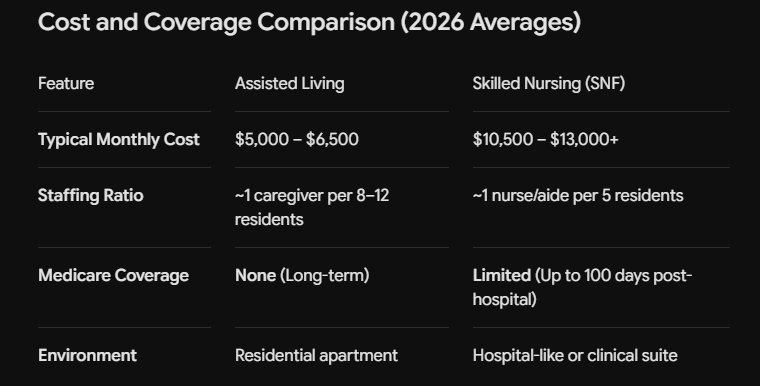
Choosing between Assisted Living and Skilled Nursing is one of the most difficult decisions a family can make. While both provide support, they are designed for vastly different stages of health.
1. Medical Supervision vs. Daily Support
The primary difference lies in the clinical oversight required.
  • Assisted Living: Best for seniors who are medically stable but need help with “Activities of Daily Living” (ADLs). They might have chronic conditions like controlled diabetes or arthritis, but they do not need a nurse on-site at all times.
  • Skilled Nursing (SNF): Required for seniors with unstable medical conditions. If your loved one needs IV medications, complex wound care (such as stage 3 or 4 pressure ulcers), or daily monitoring by a Registered Nurse, they have crossed the threshold into skilled care.
2. The “Rule of Three” for ADLs
Geriatric care managers often look at how much physical help a senior needs with basic self-care.
  • The Tipping Point: If a senior requires “total assistance” (they cannot participate in the task at all) with three or more of the following, a nursing home is usually the safer choice:
    1. Feeding: Inability to bring food to their mouth or a need for a feeding tube.
    2. Toileting: Total incontinence care and inability to manage hygiene.
    3. Transfers: Requiring a mechanical lift (like a Hoyer lift) or two people to move from bed to chair.
3. Cognitive Safety and Wandering
While many Assisted Living facilities have “Memory Care” wings, there is a limit to the behaviors they can manage.
  • Assisted Living is appropriate if: The senior is confused but can be redirected and does not pose a physical danger to themselves or others.
  • Skilled Nursing is required if: The senior exhibits aggressive behaviors, severe “exit-seeking” (trying to break out of secured doors), or “sundowning” that requires clinical intervention or specialized geriatric psychiatry.
4. The “Post-Acute” Recovery Phase
Sometimes the choice is temporary. If your loved one is leaving the hospital after a stroke or hip fracture, they likely need Skilled Nursing for intensive rehabilitation (PT/OT/ST). Once they regain enough strength to perform basic tasks, they can often “step down” to Assisted Living.

References & Resources

  • American Health Care Association (AHCA): Clinical Guidelines for Senior Placement and Resident Acuity (2025-2026).

  • Medicare.gov: Your Guide to Choosing a Nursing Home or Other Long-Term Care (2026 Edition).

  • Journal of the American Geriatrics Society: Predictors of Transition from Community-Based Assisted Living to Skilled Nursing.

  • National Center for Assisted Living (NCAL): State-by-State Regulatory Requirements for Assisted Living Admission.

Is your loved one currently in the hospital, or are you noticing a gradual decline at home?

Related Posts: